
Pietro Genova Gaia - In five pieces
Hey readers!
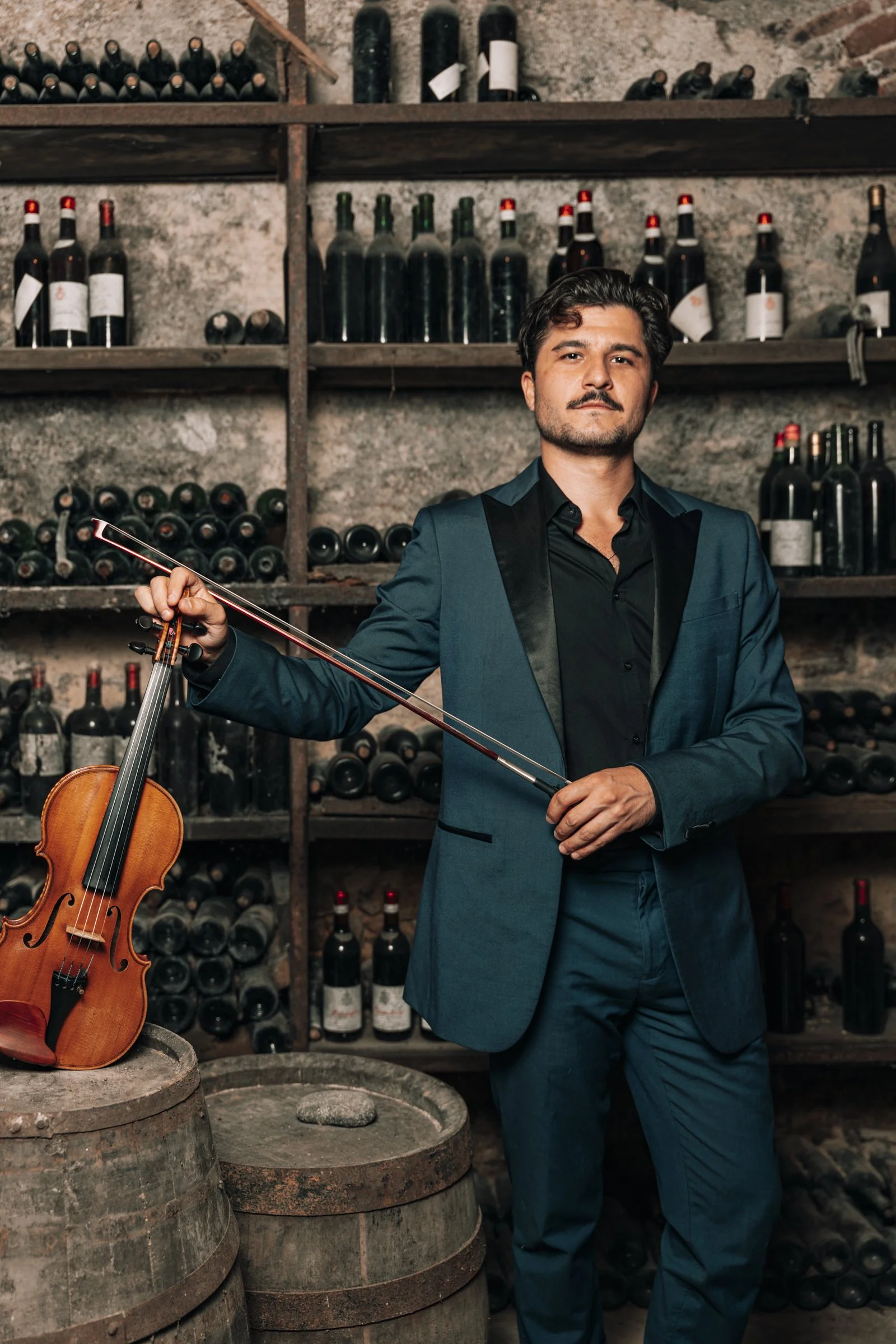
For our next In five pieces blog, I had a chat with - violinist and founder of Sunday Musicians Cafe Pietro Genova Gaia🎶
Pietro Genova Gaia was born in Genoa - he began playing the piano at the age of five and then the violin at the age of seven. He studied at the Niccolò Paganini Conservatory in Italy, earning his diploma. He then toured Italy and Europe, performing concerts, and continued his studies in Berlin at the UDK. Pietro later won an audition at the Royal College of Music in London, where he completed his master’s under Itzhak Rashkovsky and had the opportunity to lead the orchestra under renowned conductors.
In addition to his musical career, Pietro holds a degree in Political Science and International Relations from the University of Genoa. He worked as music tutor of El Sistema, with Trillargento association, in Genoa for 3 years. He has also been involved in various entrepreneurial projects in London, including being founder of a concert series at Netherhall House Auditorium in Hampstead, and producing a podcast called “Sunday Musician’s Café.”
Currently, Pietro is a violin teacher in London, collaborating with the Royal College of Music’s teaching services for graduates and teaching at Bromley Conservatory. He performs as a soloist, he is invited in chamber music festivals, to perform with different groups in London and is currently the assistant to the music director at Keshet Eilon, a renowned international music center.
1. Cello Suite no.1 - J.S. Bach
(Listen here → YouTube link)
Bach’s Cello Suites, written around 1720, are some of his most intimate and enduring works. Though originally for cello, they’re often played on violin, where their dance movements feel fresh and clear. The First Suite in G major is a favourite starting point for many musicians - simple, expressive, and full of warmth. Its Allemande beautifully shows Bach’s blend of structure and freedom, which keeps the suite timeless.
Why it stays with me:
I would start with the Bach Cello Suite No. 1, arranged for solo violin. It was my first real approach to Bach, and I still vividly remember the lesson I had on the Allemande from the first suite. I was just 10, and I still return to that piece whenever I feel the need to fall in love with the violin again - to experience the beautiful freedom and sense of liberty in the phrasing that those ancient solo dances hold. Now I am 28, and though I recently gave a solo recital full of technically difficult pieces, I knew I wanted to begin with that First Suite as an homage to my late first teacher, and also as a big hug to the child who started loving the violin - and Bach in particular - at such a young age.
2. Scottish Fantasy - Bruch
(Listen here → YouTube link)
Max Bruch (1838–1920) was a German Romantic composer best known for his rich melodies and lyrical writing for violin. Although he wrote many works, his Violin Concerto No. 1 and Scottish Fantasy remain his most beloved pieces, celebrated for their warmth, emotional depth, and beautifully crafted themes.
Scottish Fantasy (1880) blends virtuosic violin writing with traditional Scottish folk melodies, creating one of the most lyrical and expressive concert works in the violin repertoire. Written for violin and orchestra, it moves between rhapsodic freedom and heartfelt song, making it a favourite for both performers and audiences. Heifetz’s iconic recording helped cement its place as a true romantic showpiece.
Why it stays with me:
Another very important piece is Bruch’s Scottish Fantasy, especially Jascha Heifetz’s recording. When I was 13, I somehow knew I would love it, so even before hearing a note, I downloaded it onto my small black MP3 player. The file was so big I had to split it into two parts - back then, a 30-minute piece felt enormous for an MP3. I listened to it repeatedly on my way to the Conservatory in Genoa, my hometown, and vividly remember imagining Heifetz playing in front of me, dreaming that I would perform it with an orchestra one day.
I subconsciously promised myself I would play it with an orchestra. In April 2022, when I was still 24, that dream came true. The orchestra was made up of exceptional musicians from the Royal College of Music, many of whom were close friends, which made it even more special. We were in Trinity Church, just in front of the RCM, with sunlight streaming through the stained-glass windows. In those moments, I felt I was praying, not just playing, and that a quiet prophecy had been fulfilled. I was overwhelmed with gratitude and joy. I still revisit that recording on YouTube, listening in disbelief and thankfulness.
3. Chaconne - J.S. Bach
(Listen here → YouTube Link)
The Chaconne from Bach’s Partita No. 2 in D minor is often considered one of the greatest works ever written for solo violin - an immense, 15-minute journey built on a repeating bass pattern that unfolds into astonishing emotional and structural depth. Composed around 1720, in response to the death of his first wife, it shows Bach at his most profound. For violinists, the Chaconne is not only a technical summit but a personal and spiritual one, a piece that evolves with you through every stage of life.
Why it stays with me:
When I was 14, I had my first encounter with Bach’s Chaconne. At the beginning, I thought it was just another piece, and that people were making too much fuss about it - treating it as something sacred and untouchable. I assumed it was simply tradition, or the attitude of an elitist circle of musicians. But once I began practicing it, I realised its difficulty and gradually understood why it is always praised as a masterpiece. It soon became one of those pieces that never leaves you. I developed a deep connection to it, and it became one of the best ways for me to cope with grief.
As you grow up, you lose more loved ones, and you learn what grief truly is. What I do now is switch off the lights, sit in the middle of the room - sometimes with a candle lit - and start playing it. At that point, I don’t care about style or technique; I just play it as it comes. Sometimes very softly and slowly, sometimes loud and full of vibrato, almost like Brahms. It might seem sacrilegious to some, but for me, it becomes a way to communicate and release all the emotions in my heart.
4. New York, New York - Frank Sinatra
(Listen here → YouTube Link)
“New York, New York” is one of Frank Sinatra’s most iconic songs - bold, catchy, and full of that big-city sparkle. Written in the late ’70s, it’s become a classic celebration of dreams, energy, and starting fresh. It’s the kind of tune that fills a room instantly, and it’s no surprise so many musicians, professional or not, love playing it.
Why it stays with me:
My father is a doctor but always wanted to be an artist. He paints extremely well and has countless creative ideas - so much so that some of his paintings have been sold and now hang in houses, small businesses, restaurants, studios, and offices. He played the saxophone when he was younger, though he never really practised. Still, I remember him playing the classic “New York, New York” by Sinatra around Christmas time. I think that’s when I slowly developed a genuine interest and love for jazz.
I often play a Sonny Rollins record from 1957 (the year my father was born) which somehow captures this personal journey into jazz for me. It’s a musical form I find increasingly incredible, one that demands real attention, sensitivity, and an openness to the unexpected.
5. String Quintet in C Major - Schubert
(Listen here → YouTube Link)
Franz Schubert (1797–1828) might have had a short life, but he packed it with incredible music full of emotion and lyricism. His String Quintet in C major, written in 1828 just before he died, is often called one of his finest chamber works. Scored for two violins, a viola, and two cellos, it has this rich, glowing sound that feels both intimate and huge at the same time. Playing it is like joining a conversation with close friends - you listen, you respond, and together you create something really special. That’s what makes chamber music so magical.
Why it stays with me:
There are so many chamber music pieces that have shaped my life and are still dear to me. I knew I had to include one of them, because my entire vocation as a musician, I believe, sits at the very heart of what chamber music means. Music is made together, even when playing solo. It’s never a lonely art - even when you’re practising alone at home.
I recently performed the Schubert String Quintet again, and it always feels extraordinary to make music together through that piece. Reading about it, and realising how close it was to Schubert’s heart, had a real impact on me. It was literally the last piece he completed. It’s a beautiful work, of course, but for me it became a way to understand even more deeply the meaning and purpose of chamber music. I’m not attached to the piece itself - though it is incredible - but to the message it carries and the sense of human connection it represents.
You can catch Pietro at our next Secret Concert at Queens House Greenwich, on Saturday 14th February.
Get your tickets here!

Saxophonist Rob Burton introduces five pieces that have been touchstones throughout his musical life, each one offering a glimpse into the influences that continue to inspire him.