
Rob Burton - In five pieces
Hey readers!
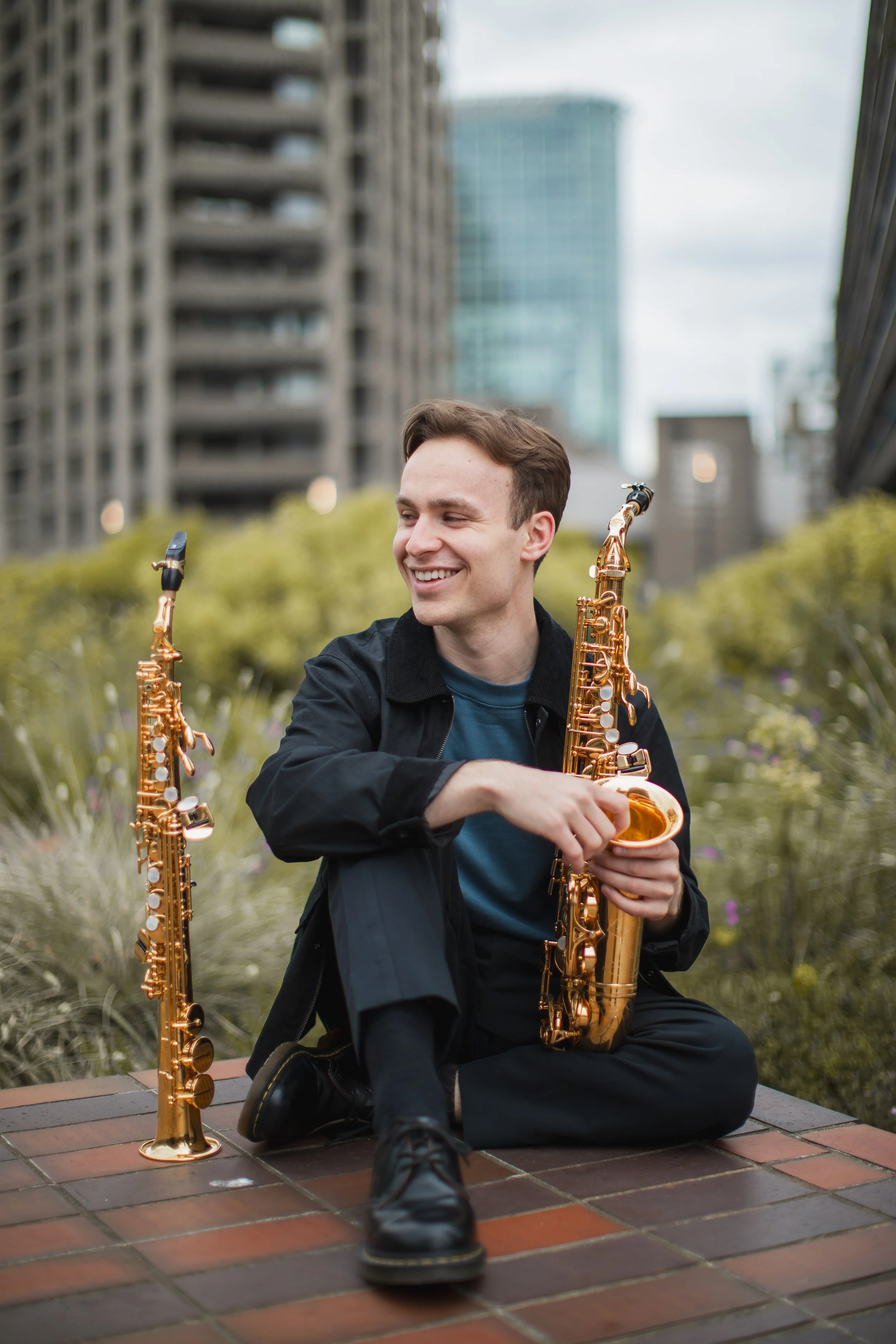
For our next In Five Pieces blog, I had a chat with saxophonist Rob Burton- who is joining us for the first time for our August secret concert double bill!
London-based saxophonist and artist Rob Burton won the Woodwind Category Final of BBC Young Musician 2018 and went on to secure a place in the Grand Final at Birmingham’s Symphony Hall, where he performed as concerto soloist with the City of Birmingham Symphony Orchestra.
Highlights since then include appearances as soloist with some of the UK’s leading orchestras, such as Britten Sinfonia and Bournemouth Symphony Orchestra as well as at prestigious international festivals, including Mecklenburg-Vorpommern, Leicester, Cheltenham, Harrogate, and Oundle International Festivals. Featured as one of Classic FM’s “Rising Stars 2024: 30 under 30”, he has performed in prestigious London venues, namely Wigmore Hall, St. John’s Smith Square, St. James’ Piccadilly, Buckingham Palace, and Windsor Castle.
Rob previously studied Classical Saxophone on a full scholarship at the Royal Academy of Music with Huw Wiggin, his master’s degree at the Zürich University of the Arts (ZHdK), and recently graduated from the Royal Academy of Music on the prestigious Advanced Diploma degree, as the first ever saxophonist on this course.
As an oil painter, Rob has spent time studying at the Barcelona Academy of Art and has appeared on Sky Arts Portrait Artist of the Year, where he was shortlisted for the semi-final.
Selected as a 2022 Rahn Kulturfonds scholarship winner and previous ‘Making Music’ artist, Rob is also a Vandoren UK artist. He is grateful for the support of YCAT's BBC Young Musician aftercare scheme, the Munster Trust, the Marianne und Curt Dienemann-Stiftung, and LSO Conservatoire Scholarships.
Romeo and Juliet Fantasy Overture - Tchaikovsky
(Listen here → https://www.youtube.com/watch?v=f6qZUCi7ToQ)
Few love stories have inspired composers quite like Romeo and Juliet, but Tchaikovsky's take remains one of the most thrilling. Written in 1869 (and later revised), this isn't an opera or ballet, but a single orchestral work that captures the drama, conflict and heartbreak of Shakespeare's tragedy in under twenty minutes.
From the ominous opening to one of the most unforgettable love themes ever written, it's a piece that wears its heart firmly on its sleeve. Sweeping, cinematic and emotionally charged, it's easy to see why it continues to captivate audiences more than 150 years later.
Why it stays with me:
Growing up as a classical saxophonist, I never really had much of a connection to orchestral music. While all of my friends were playing in youth orchestras and enjoying symphonic works from the age of 10 or so, even into my teens I had rarely heard a symphony orchestra, let alone played in one.
During my A-levels, I took a chance on listening to an orchestral work of my own accord. For some reason, I knew that Tchaikovsky had written a piece relating to Romeo and Juliet. It quickly became the soundtrack to my A-levels. I listened to it every single day at school on YouTube while revising and completely fell in love with the beauty and sheer epicness of this piece.
2. Café 1930 from Histoire Du Tango - Astor Piazzola
(Watch here → https://www.youtube.com/watch?v=aM8iJOQ7gio)
Argentinian composer Astor Piazzolla transformed the tango from dance hall entertainment into concert music (and is a regular composer to feature in our secret concert programmes!), blending the traditions of Buenos Aires with jazz and classical influences. Histoire du Tango traces the evolution of the genre through four snapshots in time.
The second movement, Café 1930, slows everything down. By this point, tango had moved from the dance floor into cafés where people gathered simply to listen. Richly lyrical and full of nostalgia, it's a beautifully intimate piece that lets melody take centre stage.
Why it stays with me:
When I started studying at Junior Guildhall aged 13, I hadn't played much chamber music before. Suddenly I was surrounded by incredible musicians, and I remember so vividly arriving at my first week of saxophone quartet rehearsals and seeing Histoire du Tango on the music stand. I shared the alto saxophone part with another new young saxophonist. Not only is it a beautiful piece, but it also takes me right back to that early memory of falling in love with chamber music.
3. Sarabande from Partita for 8 Voices - Caroline Shaw
(Listen here → https://www.youtube.com/watch?v=tRx23jyiqfY)
American composer, violinist and vocalist Caroline Shaw has become one of the defining voices in contemporary classical music. Born in North Carolina in 1982, she's just as comfortable performing on stage as she is writing for some of the world's leading musicians. Alongside her concert works, she's composed film and television scores, collaborated with artists including Rosalía, Nas and Kanye West, and is a member of the Grammy-winning vocal ensemble Roomful of Teeth.
When Shaw became the youngest-ever recipient of the Pulitzer Prize for Music in 2013, it was Partita for 8 Voices that caught the world's attention. Written for Roomful of Teeth, the work draws inspiration from Baroque dance forms but reinvents them using speech, whispers, breath, singing and an astonishing range of vocal techniques. The Sarabande is haunting, hypnotic and unlike almost anything else in the classical repertoire - a reminder that the human voice can be an orchestra all by itself.
Why it stays with me:
In 2019, I attended a talk at the Royal Academy of Music by violist (and powerhouse) Nadia Sirota. The talk was incredibly formative and led me to discover Nadia's podcast, Meet the Composer, which became my introduction to contemporary music - something I hadn't had much contact with before.
On my morning walks through Regent's Park to practise at the Academy, I listened to an episode about Caroline Shaw and quickly fell in love with her Partita for 8 Voices, recorded by the American vocal ensemble Roomful of Teeth. Listening to it felt like it was creating new pathways in my brain. It completely opened my eyes.
4. Violin Sonata op.11 no.4 - Paul Hindemith
(Listen here → https://www.youtube.com/watch?v=IDC9HIpreK8)
Paul Hindemith was one of the twentieth century's great musical all-rounders: composer, conductor, teacher and, crucially, a brilliant violist. It's no surprise that he wrote some of the instrument's most important repertoire, helping to elevate the viola from orchestral middle voice to compelling solo instrument.
His Viola Sonata, Op. 11 No. 4 is youthful, energetic and packed with personality. By turns lyrical, playful and technically demanding, it showcases the instrument's rich, warm sound while revealing why Hindemith remains such an influential figure in chamber music.
Why it stays with me:
Wow, just wow! Lots of people say Hindemith is a bit hit-or-miss, but if that's you, then this is definitely a hit. This sonata is absolute compositional genius. Not only does it contain some of the most beautiful moments I've ever heard in classical music, but it also absolutely slaps!
Luckily, the viola has a very similar range to the alto saxophone, so I've been fortunate enough to perform this piece on a few occasions. It is so epic!
5. The Centre is Everywhere - Edmund Finnis
(Listen here → https://www.youtube.com/watch?v=4ONA6qhVufs)
Born in Oxford in 1984, Edmund Finnis is one of Britain's most exciting living composers. After studying at the Guildhall School of Music & Drama, he has gone on to write for artists including Jess Gillam, Sheku Kanneh-Mason and Víkingur Ólafsson, as well as ensembles such as the London Sinfonietta and Manchester Collective. Alongside composing, he's Professor of Composition at the Royal Academy of Music in London.
Finnis' music often takes its inspiration from architecture, landscapes and the tiny details we might otherwise overlook. The Centre is Everywhere, originally written for twelve string players, has become one of his best-known works, not least thanks to Manchester Collective's acclaimed recording. It's music that unfolds patiently, revealing shimmering colours and delicate textures the longer you spend with it - proof that some of the most powerful musical moments happen at a whisper, not a roar.
Why it stays with me:
Another piece that makes me feel like my brain is expanding. I discovered it in 2021 and have listened to it hundreds of times since. There's something so kaleidoscopic about this string orchestra piece that scratches my brain in the most amazing way.
I love contemporary music that looks back to earlier musical styles - whether Medieval, Renaissance or Baroque - and Edmund Finnis does this so beautifully.
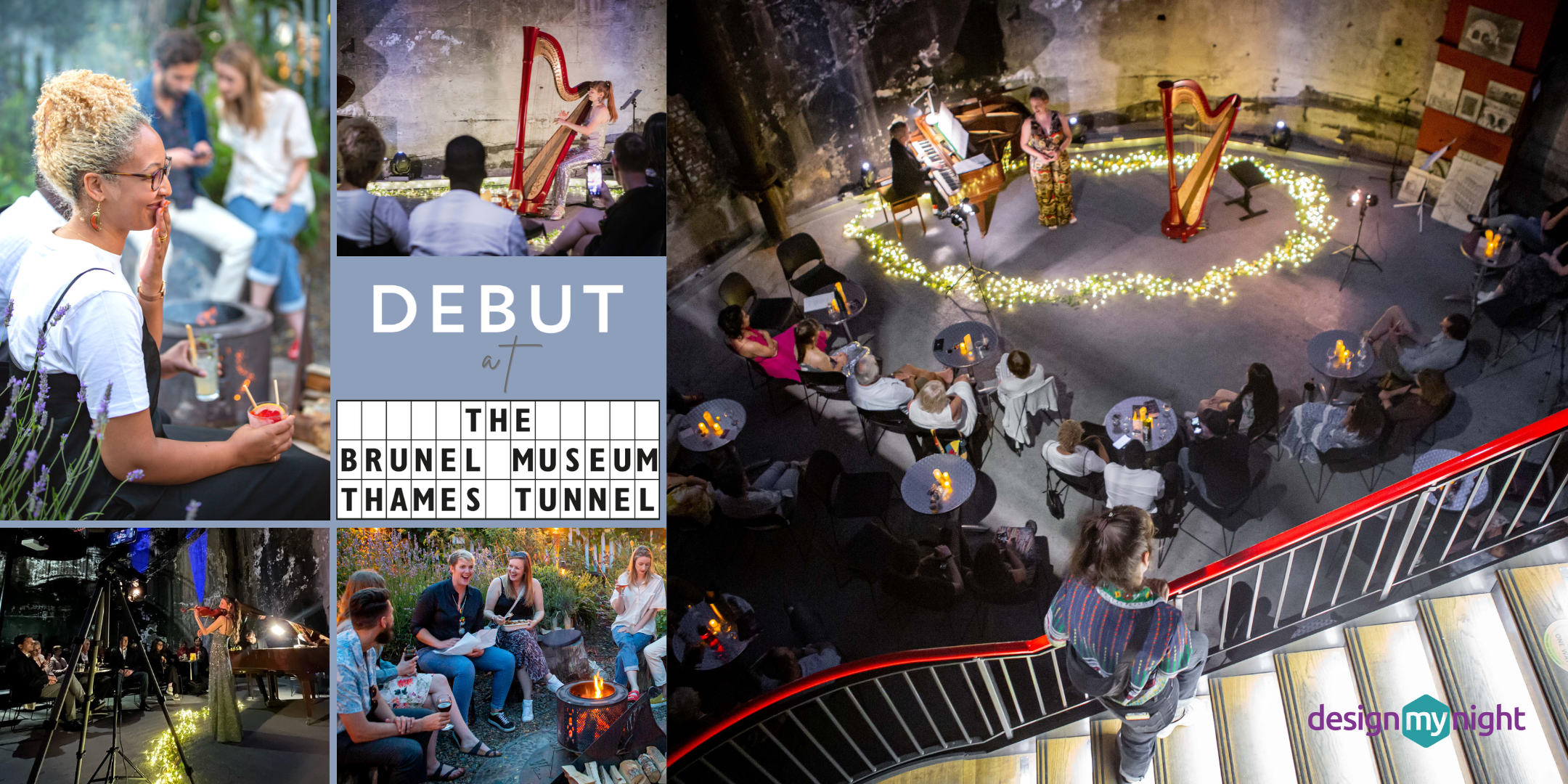
Rob is joining us for our August double bill - 13/8 at Brunel Museum & 22/8 at Shoreditch Treehouse!
Tickets are selling fast so grab yours quick!

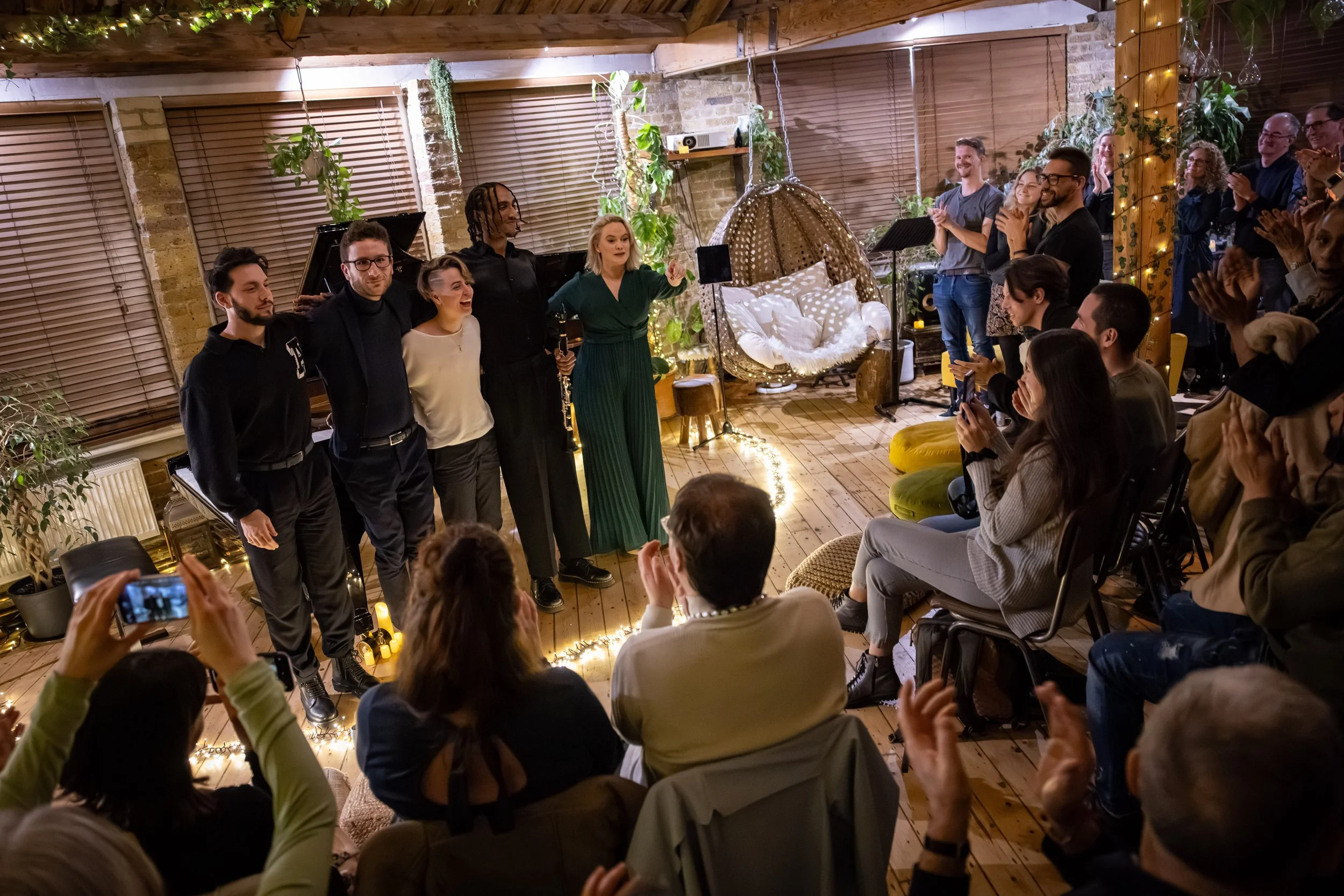

Experience DEBUT's flagship secret concert at the magical Shoreditch Treehouse, a hidden gem nestled in the heart of Shoreditch, with a Steinway Concert Grand piano under a canopy of twinkling fairy lights.
MUSICIANS
Shafali Jalota - soprano
Pedro Lopez - flute
Panaretos Kyriatzidis - collaborative pianist
Lizzie Holmes soprano & host
Sam Peña - resident pianist & improvisor