
Poppy Beddoe - In five pieces
Hey readers!
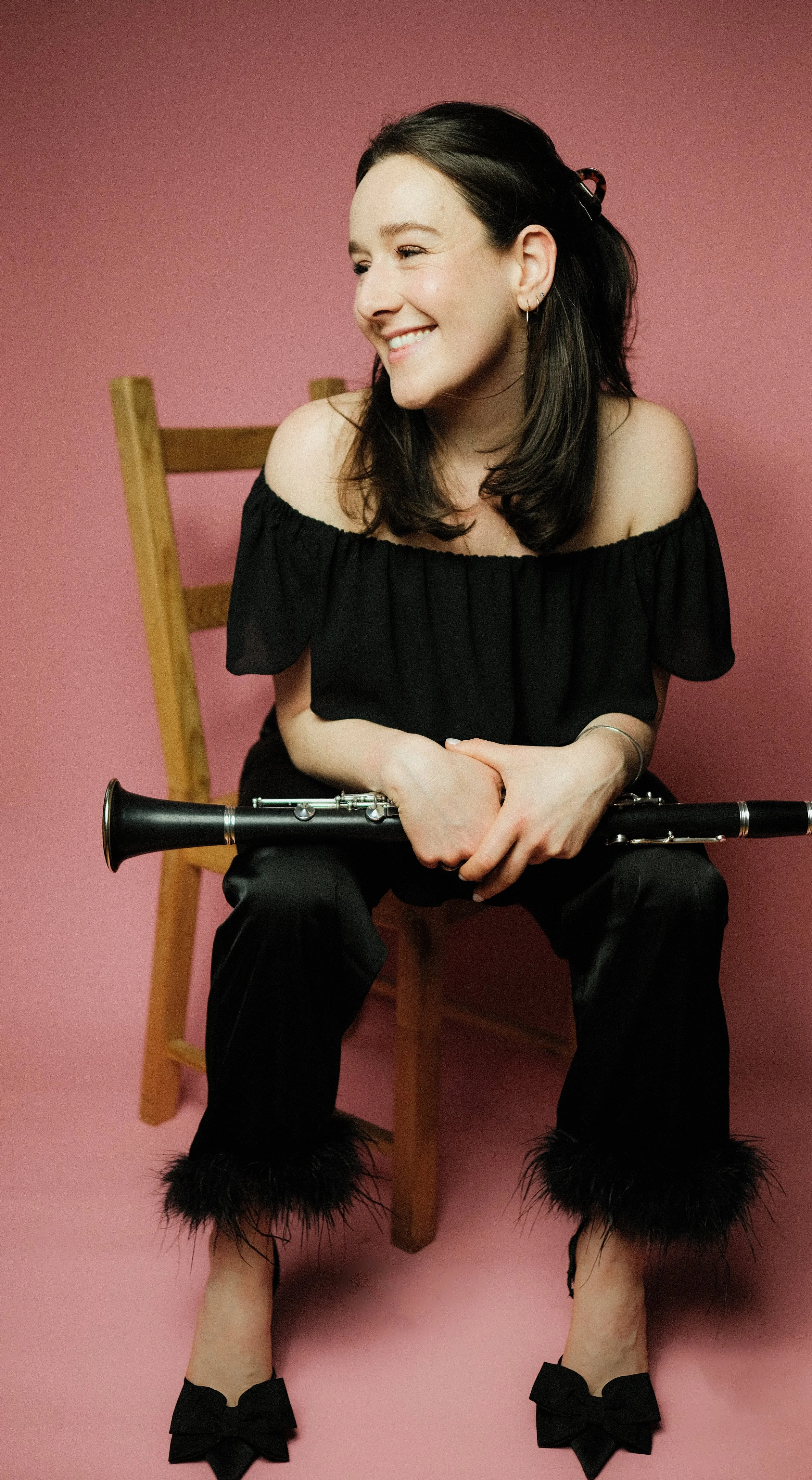
For our next In Five Pieces blog, I had a chat with clarinettist Poppy Beddoe. Poppy is making her debut with us on Saturday 30th May at Shoreditch Treehouse.
Poppy Beddoe is a versatile solo, orchestral, and chamber clarinettist, performing widely across the UK and internationally.
Her debut album Soliloquy (2021, Ulysses Arts) features her own transcriptions of works by Bach and Hildegard of Bingen. Recent highlights include the premiere and recording of Matthew Taylor’s Concertino (written for her) with the BBC National Orchestra of Wales, released by Toccata Classics and broadcast on BBC Radio 3.
Poppy has appeared as a Guest Artist at the University of Houston and the Texas New Music Festival. Recent and upcoming concerto performances include Mozart’s Clarinet Concerto with the Piccadilly Sinfonietta, Malcolm Arnold’s Second Clarinet Concerto at the Malcolm Arnold International Festival, and the Rietz Concerto with Bushey Symphony Orchestra. Other 2026 engagements include recitals at Blackheath Halls, on the Rachmaninov Piano Boat and chamber music for Clare Hall, Cambridge and at the St Magnus International Festival.
Committed to music education and outreach, Poppy teaches at the Junior Royal Academy of Music and works with its Widening Participation team. She also tours with MishMash Productions, bringing classical music to young audiences.
She is Artistic Director of the Berkshire Chamber Music Festival and a concert series in the South of France.
In 2023, she was elected an Associate of the Royal Academy of Music for significant contribution to the profession. She studied music at King’s College London and completed her Master’s at the Royal Academy of Music in 2016.
When not playing the clarinet she can be found either walking with or talking about her Labrador, Hiccup.
Angel of the Morning – Juice Newton
(Listen here → https://www.youtube.com/watch?v=HTzGMEfbnAw)
Angel of the Morning was written by Chip Taylor in 1966 and has been recorded by numerous artists, although Juice Newton’s 1981 version became the most commercially successful. The song reached the top ten of the Billboard Hot 100 and became closely associated with the soft rock and country-pop sound of the early 1980s.
Before Newton recorded it, the song had already developed a long performance history, with notable versions by Merrilee Rush, Olivia Newton-John and Nina Simone. Its enduring popularity has led to frequent appearances in film, television and advertising, giving it an unusually broad cultural life for a song originally released in the 1960s.
Why it stays with me:
My mum, sister and I will sing this at the top of our lungs in the car much to the annoyance of the rest of the family. I always listen to this when I’m nervous before concert because it calms me down; it’s been a constant throughout my life. An absolute bop which I associate with my favourite people.
2. Bruckner 8 – Final Movement
(Listen here → https://www.youtube.com/watch?v=hbTqmBOjjyQ)
Anton Bruckner was a nineteenth-century Austrian composer best known for his monumental symphonies and expansive orchestral writing. His Symphony No. 8 is his longest and largest symphony, often lasting around eighty minutes in performance. The work exists in multiple versions because Bruckner revised it extensively after criticism from conductor Hermann Levi, who initially rejected the original score.
The final movement is particularly notable for its monumental orchestration and structural complexity. Bruckner combines themes from earlier movements in a large-scale symphonic conclusion, creating dense layers of brass and strings that have become characteristic of his late style. The symphony is frequently described as “cathedral-like” because of its massive architecture and expansive sense of space.
Why it stays with me:
An absolute banger which I recently discovered. I will happily listen to the first few minutes over and over again (which is probably not something I should admit). Bruckner’s clarinet parts aren’t necessarily particularly exciting but I love the brass writing and how he writes with blocks of sound rather than particularly exciting melodies. He was quite a peculiar man but he can find a depth of sound like no other composer!
3. The Marriage of Figaro by Mozart
(Listen to the overture here → https://www.youtube.com/watch?v=Mp6UAGN_Ir4)
Mozart composed Le Nozze di Figaro (The Marriage of Figaro) in 1786 with librettist Lorenzo Da Ponte, adapting a play that had caused huge controversy in France because of its jokes about aristocrats and servants outsmarting their masters. Although the political edge was toned down for the opera, the chaos, disguises and ridiculous misunderstandings all survived.
The opera is often described as hit after hit because Mozart somehow manages to pack unforgettable music into almost every scene. The overture is one of the most recognisable in opera, even though it doesn’t actually contain any melodies from the rest of the work. One of the most remarkable things about the opera is how naturally the characters interact musically - instead of stopping the drama for big solo arias, Mozart lets emotions, arguments and comedy unfold all at once through enormous ensemble scenes.
Why it stays with me:
I think this opera is pretty much perfect, hit after hit. This is definitely a bucket list piece for me, I would happily play it over and over again. I’m also desperate for someone to write a fantasy on themes from this opera. The clarinet lends itself so well to operatic writing and I think a fantasy would be amazing! Maybe I will commission it in a few years time.
4. Antiphon from 6 Mystical Songs by Ralph Vaughan Williams
(Listen here → https://www.youtube.com/watch?v=R-Ef8osGX88)
Ralph Vaughan Williams was one of the most important British composers of the twentieth century, famous for music inspired by folk songs, hymn tunes and huge sweeping orchestral soundscapes.
Antiphon is the final movement of Vaughan Williams’ Five Mystical Songs, a set of pieces written between 1906 and 1911 using texts by the seventeenth-century poet George Herbert. The work premiered at the Three Choirs Festival in Worcester and has remained one of Vaughan Williams’ most loved choral works ever since.
Unlike some of the quieter earlier songs in the cycle, Antiphon bursts into life with the line “Let all the world in every corner sing.” The movement builds into a massive choral celebration full of ringing harmonies, organ-like orchestral writing and the sort of glorious sound that seems designed for huge cathedrals and echoing spaces.
Why it stays with me:
Just heaven in three minutes. I didn’t know it until I heard my niece sing it with her school in St Paul’s cathedral and have been obsessed ever since! I don’t usually love VW but this is epic. My grandmother apparently loved these mystical songs so that makes this movement even more special. I would have loved to listen to them with her.
5. Beethoven - Violin Concerto
(Watch here → https://www.youtube.com/watch?v=cokCgWPRZPg)
Beethoven’s Violin Concerto premiered in 1806 with the violinist Franz Clement as soloist, although the first performance was apparently so under-rehearsed that Clement was forced to sight-read parts of it on stage. Audiences at the time didn’t really know what to make of it and the piece disappeared for decades before being revived in 1844 by the twelve-year-old violin prodigy Joseph Joachim, conducted by Felix Mendelssohn.
What makes the concerto so unusual is how symphonic it feels. Rather than the orchestra simply accompanying the soloist, Beethoven gives both equal importance, creating a huge sweeping structure that feels far bigger than a typical concerto of the time. The opening was also incredibly strange for audiences in 1806 - instead of a dramatic flourish, Beethoven begins quietly with repeated timpani notes before gradually unfolding the music. He later arranged the concerto for piano as well, and in true Beethoven fashion even included timpani in the solo cadenzas.
Why it stays with me:
Forty minutes of pure joy. Beethoven is the musical love of my life and so I couldn’t miss him out. He understands humanity; excitement, happiness, pain, grief and sometimes just silliness. I am smiling from the first three notes of the oboe entry and won’t stop until the very end of the piece. There is a transcription for clarinet and I can’t work out if I am desperate to play it or whether I think that it should be left alone. It wasn’t very successful in Beethoven’s lifetime but I think it is perfect.
Make sure to grab your tickets for 30th May to see Poppy perform with us!

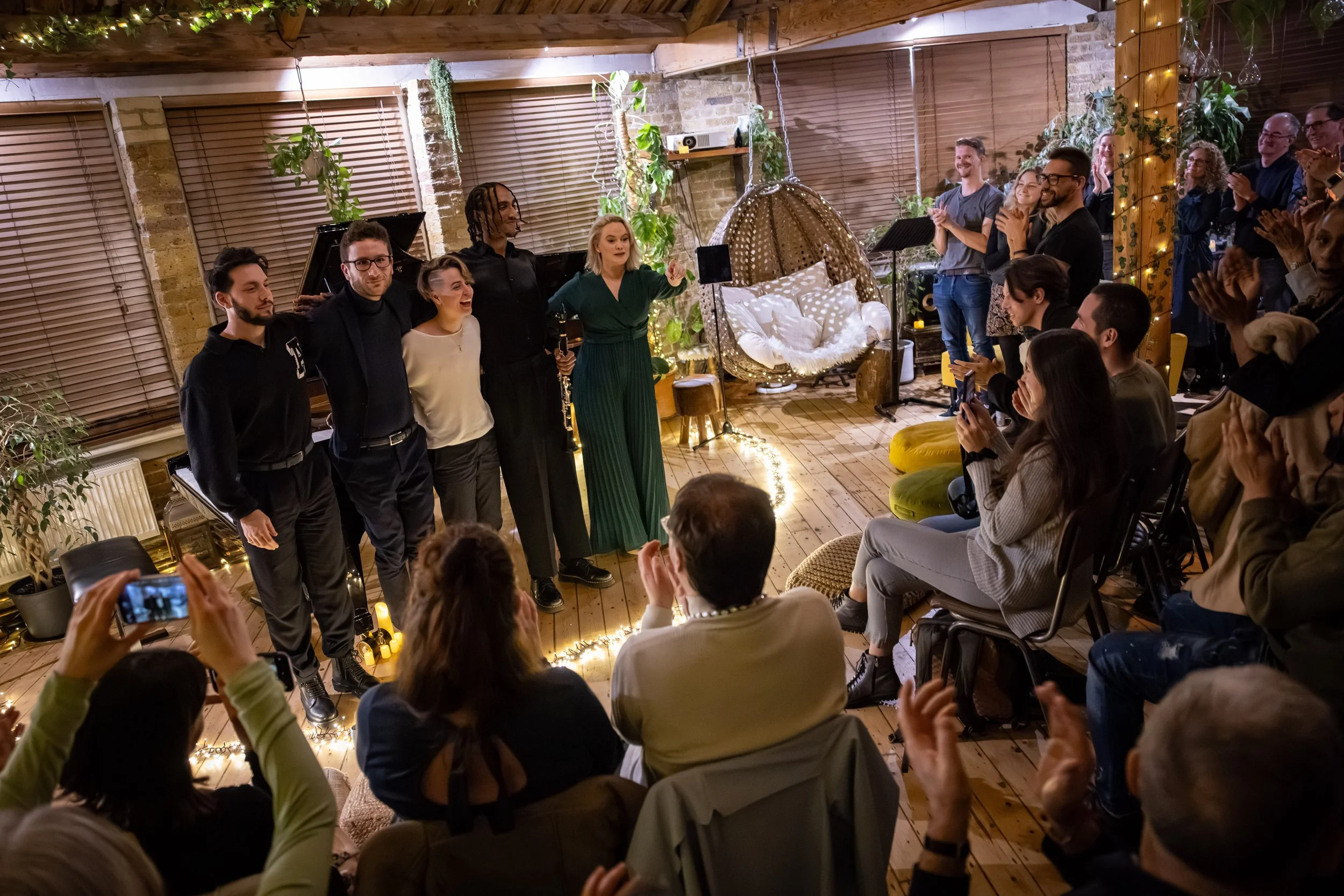

Experience DEBUT's flagship secret concert at the magical Shoreditch Treehouse, a hidden gem nestled in the heart of Shoreditch, with a Steinway Concert Grand piano under a canopy of twinkling fairy lights.
MUSICIANS
Shafali Jalota - soprano
Pedro Lopez - flute
Panaretos Kyriatzidis - collaborative pianist
Lizzie Holmes soprano & host
Sam Peña - resident pianist & improvisor